Showing posts with label design. Show all posts

Wednesday, October 22, 2014

The Uncanny Valley and #ReneeZellweger

Yesterday the news was filled with photos of Renee Zellweger. Lots of people have weighed in on her new look; my reaction is "live and let live." My only hope for her is that she is happy and ignoring the Internet right now. In my opinion, she is and was always beautiful.


Why are people reacting so strongly to her change in appearance? I was fascinated by the collective reaction and discussion. It reminded me of the Uncanny Valley, people's simultaneous attraction/revulsion reaction to things that are "almost" human, particularly virtual or robotic representations. Basically, people get creeped out. Check out this article for some examples.

I'm not suggesting that Renee Zellweger doesn't look human, but I am suggesting that she doesn't look like the Renee Zellweger we remember from Bridget Jones or Jerry McGuire. We have an expectation of the visual representation of "Renee Zellweger" and her new appearance looks "almost Renee Zellweger," just as many realistic human robots look "almost human."

It's that violation of our expectations that causes our reaction, that "close but not quite" feeling, causing us to make comparisons of what we're seeing to what we have seen and try to hone in on what is different. It's a tension that we struggle to resolve, and when we can't, we are revulsed, creeped out, angry or sad.

As an immersive learning designer, it's a good reminder that people have a deep, immediate emotional response when their expectations are violated, especially to discrepancy or changes in characters, often in a negative way. As a human being, it's a good reminder to be gentle with each other, and today, to be gentle with Renee Zellweger.

Sunday, September 14, 2014

#draw21days Day 18: Cardboard doodles

Despite my solo-parenting weekend, I'm actually finding quite a bit of time to catch up on my drawing. As I'm getting to the end of the challenges, I'm starting to wonder what's next and how I can keep this practice going. I've never thought of myself as an artist, but I'm starting to not be able to picture NOT drawing. Maybe it's time for some art lessons? Maybe I should check out the other courses on lynda.com? :)

Last night I was checking in with the littlest Pagano and my husband before their bedtime. The little guy was describing his "invisible friend" who lives in California while he's away. His name is Burn and he has a fiery tail and likes to give you sunburns. Doesn't sound like a very nice guy, but I decided to try to draw what he might looks like for my Day 18 challenge. Here's Burn:


I still had a lot of cardboard left and time to kill while I worked with my 6th grader on math homework, so I also drew Burn's nemesis, Cooly McFishy.


I've also decided that I'm not that excited by doodling, but at least this was a chance for me to practice the graphical/cartoon style that I've been struggling with.

I did like working on the thicker cardboard as opposed to paper, and working with pen instead of pencil was a little unnerving...I'm still not that confident! But at least I'm taking chances!


Saturday, September 13, 2014

#draw21days Day 16: Drawing design & Day 17: Window to the soul

I'm back in it!

After getting past the dinosaurs on Day 15, I broke out my new sketch pad and pencils and worked on the next two challenges this morning.

Day 16's challenge is to draw an iconic image of an owl, using photo references to guide your drawing. Graphical style drawings are not my strong suit, or at least I don't feel super confident in those drawings. I took a couple passes to try to get more "logo-like" but I also wanted to take my new pencils for a spin, so I still did some shading.


This is one that I might come back to and try to get more graphical, but I do like how my owls turned out.

Day 17...eyes! Yay!

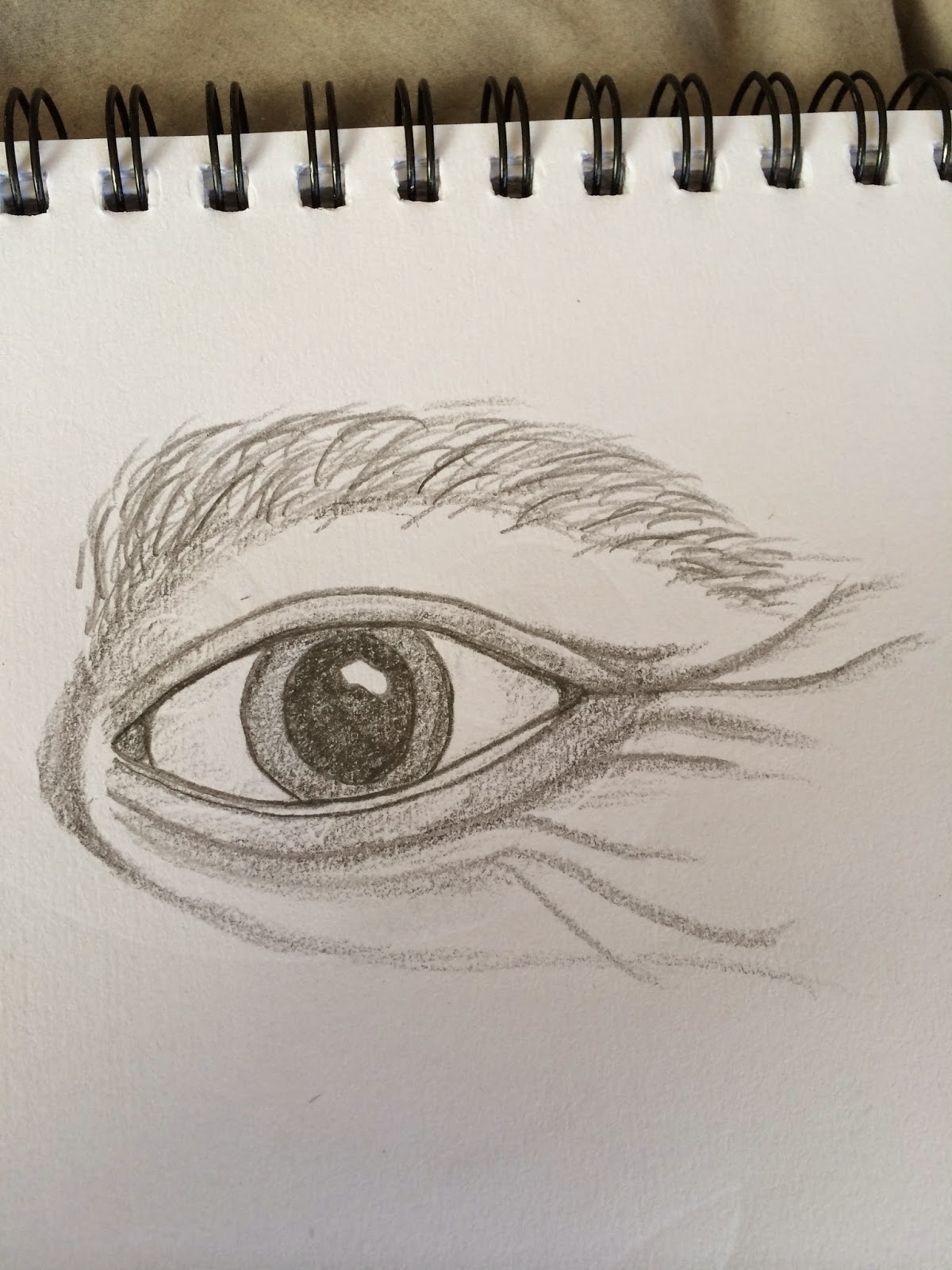
I used to doodle eyes constantly, so the biggest challenge with this challenge was not falling into my old doodling patterns. The challenge was to do 2 drawings, 1 realistic and 1 graphical. I used a photo of John and I as a reference and drew John's left eye. I really like how it turned out.


Coming off the realistic eye, I had to do a couple "in between" drawings before I got more graphical. One of the things I was thinking of was how difficult being a cartoonist would be for me, as I really struggle with simplicity and consistency of shapes. This is definitely something to work on!

A few more challenges to go...I'm already wondering what to do once the 21 challenges are complete.

Friday, September 12, 2014

#draw21days: Day 15: Boxing Dinosaurs

It's been well over 21 days, but I'm not giving up on the drawing challenge! I could tell you all about how busy I've been (true), but the abbreviated story is: ahhhhh...life :)

Tonight my house is full of teenagers and I'm down a spouse, so while I chaperone, I'm drawing. 

AND! I got myself actual drawing supplies! Nice art pencils, colored pencils, and an honest to goodness sketch pad. I don't think they will help my drawing skills much, but since I've really started to like drawing, I wanted to get some supplies better than whatever I could scrounge from my kids' school supplies.

A confession: I haven't wanted to do the Day 15 Challenge. Like, I REALLY didn't want to do it. I don't even know why. I don't have anything against dinosaurs, and it didn't seem that hard. Still, every time I thought about completing the challenge, I'd think, "no." I even considered just skipping it and going on to the next challenge, but I'm stubborn and wanted to do the challenge in order. 

So here it is. I drew dinosaurs in boxes, and one having tea. The T-Rex is sitting at my 8th grader's request, who told me as I was finishing up the brontosaurus that he always pictures T-Rexs sitting (he doesn't know why).


Now that I've broken the Day 15 barrier, I'm hoping the rest of the 21 days come more easily. 

Rawr!

Thursday, August 14, 2014

#draw21days : Day 8: Light Source

When you take on a 21-day challenge, you have no idea what events external to the challenge itself might transpire that make completing the challenge...challenging. Going into these 21 days, I didn't anticipate mourning the death of Robin Williams, sitting with my own experiences with depression, the shock and horror of the events transpiring in Ferguson, MO...it hasn't been an easy week.

And yet, here I am, completing my 8th day of learning something new. Appropriately, the 8th day challenge was about shading and light, with a varying light source. With everything swirling in my head, it was hard to focus on the light source. I found myself struggling to complete the challenge, but I kept at it. Here's the result.


It seems appropriate, given the last couple dark days, that I should practice focusing on sources of light. I'll take this timely metaphor, thanks :)

Tuesday, August 12, 2014

#draw21days Day 7: What do you like?

Today's challenge's timing was interesting, since I just came off of drawing a mermaid for the cubism challenge. I decided to draw another mermaid, this time in a more cartoon style. I struggled with her arms, and I'm still not sure I like her face, but I like the sand dollar top and the shading on her tail scales turned out quite nice. Not bad for a lunchtime drawing break!


I'm thinking I should really try to draw more mermaids in different styles, as inspiration for my next tattoo...maybe a pirate mermaid?

#draw21days Day 5: Iteration & Day 6: Cubism

Doubling down on blogging the 21-Day Drawing Challenge for days 5 & 6!

I knew Day 5 was going to be a challenge when I heard the word "iteration"...I have been spending a lot of time on my drawings and the thought of drawing them again and again seemed daunting. And it was.

I decided to draw a skull, mostly because I tried to draw a shark and it was such a train wreck that I didn't think I could bear to keep reiterating on it. My first skull wasn't much better.


Nor was my second.


But my third skull was a definite improvement, and I began to feel a little hopeful that I could do this.


I then decided to try something completely different and make a skull form from smaller drawings. I think this idea is pretty cool and I was optimistic about the end result.


But try as I might to get excited about it, I kept going back to my third drawing and making improvements, adding shading, and eventually I just focused on making that skull the best I could.


The end result is good, but the issue I had overall was time. I just didn't have enough to dedicate to the amount of work I wanted to do with this drawing. At some point I just called it "good enough," but I do wonder if, with a lot more time, I could have improved on the skull a lot more. Maybe this is a good one to come back to?

Day 6 proved a lot easier: cubism! I LOVE this style, and when I saw one of the options was "sea creature," it was pretty much done that I was going to draw a mermaid. Mind you, although I love this style, I don't think I've ever drawn anything cubistic, so I wasn't sure how it would turn out. I had particular difficulty figuring out her hands, and I ended up adding an oyster with a pearl for her to hold as a solution. I love her hair and I think her tail turned out quite well.


This may have inspired me to try to draw my own mermaid tattoo...

Tuesday, August 5, 2014

#draw21days Challenge Day 2: Continuous Line Drawings

The Day 2 challenge posted and I feel like I'm in way over my head, after taking great pride in my cat drawing yesterday. The challenge today was "continuous line drawings" and we needed to draw 4 of them: a smiling face, a hand holding a soda bottle, a man riding a unicycle, and a running dog.

My first question was: how do I draw a continuous line drawing? Are there rules? If I pick up my pencil, do I lose? Can I go back over previous lines? Is it just a matter of not taking my pencil off the paper? What if I really screw up? Can I go back and erase the mistake and pick up where I left off, or do I need to start all over again?

Clearly I'm a perfectionist and not used to this loosey-goosey direction of "draw a continuous line drawing."

I'm stressed. But I did the drawings, so there's that at least.

First, I started with the smiling face:


I was not sure what the heck I was doing, so I kept it REALLY simple. It's not bad, but it kinda looks like some kind of free icon. 

Next I drew the hand holding a soda bottle. This one was really hard, and I did erase the bottle a few times and start over because I couldn't get the size perspective quite right. I did decide to do some shading (without lifting my pencil, since I was so concerned with doing it "right"), and I decided with this drawing that it was ok to go back over lines I'd already drawn as long as I didn't lift my pencil. Makin' up my own rules ;)


I was a little more confident going into the man riding a unicycle and a little less concerned about how to add detail once I gave myself permission to draw over previous lines. He looks a little like elastic man, but I am pretty proud of my glasses/eyes/nose/mouth combo, as well as the tire treads. This one was hard, but I enjoyed trying to figure out the little details (even though his arms and shoulders need some work!). 


The last drawing I completed was the running dog. I looked up some images on Google of dogs running for inspiration, and I picked a little dog that looks a lot like one of our dogs, Sherlock. I decided to try shading again, to get the feeling of fur. I liked drawing this one the most, even though I was not at all sure how to capture the idea of motion.


So there you have it! Day 2 is on the books. I'll be interested to see everyone else's drawings, how they interpreted "continuous line" and hear what challenges they faced. I'm already looking forward to tomorrow's challenge!


If you're interested in joining the 21 Day Drawing Challenge, check out the lynda.com Facebook page for more info! https://www.facebook.com/lynda/app_143103275748075?ref=ts&app_data=source-FBpost

Monday, August 4, 2014

Learn something new

I've worked at lynda.com for over 2 years and I'm ashamed to say that I've spent very little time learning on our site. I've spent lots of time on our site for work, and as Director of Product Management for our Enterprise products, I've spent lots of time talking to all kinds of people about how they use or would like to use lynda.com in their organizations. You'd think that I'd be a lynda.com power user, but the truth is, once I log off my computer at the end of the work day, I usually don't log back in, even though I really want to take ALL of the photography classes and my pivot table knowledge in Excel could use some refreshing.

I've been thinking about how immersive learning design applies to me expanding my other design skills. I wrote a whole book on immersive design and still I struggle just like everyone else to find the motivation to jump in an practice a new skill consistently to improve my performance. I have two skills I want to master by the end of this year. First, I want to be able to play my Evelyn Evelyn ukelele from Amanda Palmer (as shown in the awesome birthday package I received a few years ago...).

Second, I want to learn how to improve my drawing skills. Ever since I hand drew wireframes for a new feature flow, my team has been making comments about my now legendary lack of drawing skills. And my newest addiction with the French Girls app has made me even more interested in pushing myself to grow in my ability to draw.

So, applying my immersive design expertise, I'm going to tackle these two goals in the context of immersive learning.

My ukelele playing is going to improve with a simple design that's a tiered system of practice/performance with the ultimate goal of playing my husband, John, a song of his choice for his 40th birthday this November. I'm still working out the performance schedule, but stepping stones include a song for our trip to Yosemite this month, a song for my daughter's birthday in September, a song for our dear friends' wedding in October, a song for DevLearn at the end of October, all leading up to a song for John's birthday. I'll keep you posted with progress!

My drawing is getting jump-started this month with a design challenge through lynda.com. It starts today, and I'm looking forward to posting my progress. If you're interested in improving your drawing skills too, draw along with me! I'd love the company, and it would be great to have some peer pressure to complete the challenge every day. You can sign up for the challenge here: http://on.fb.me/SfajBd

I've already completed today's drawing challenge, "draw a cat." So far, so good...


If immersive learning is learning by doing, then let's do this!

Monday, March 24, 2014

Learning through "infuriating feedback"

One of the things that I'm most passionate about doing well when designing learning is providing feedback. In immersive design, practice without feedback is useless, and often can reinforce the wrong behaviors. For example, if you're trying to perfect your golf swing, heading to the driving range and hitting a bucket of balls without the guidance of a golf pro to help critique your form may lead you to practicing a whole bucket full of bad swings. 

Yet very rarely do any of us perform a task in a vacuum; we're constantly bombarded with feedback, both subtle and obvious, that reinforces what we're doing well and discourages us from continuing less than stellar behaviors. We love hearing the good stuff, getting that positive reinforcement. In game design, quick victories are by design to make players feel good, feel confident, hoping to hook them in to continue playing even as game play becomes more difficult and complex, and victories and positive reinforcement are harder to come by. In "real life," the same dynamic exists. I love to hear the feedback of people after I speak, to hear how something I said struck a chord or helped them make a connection or see something in a different light. Even better, I love when people compliment my kiddos, as that provides me with some positive evidence from non-biased sources that I'm doing ok in the toughest job that I have.

Negative feedback, critique and even punishment surround us every day too. I am always amazed as a mom about how often I have to say, "chew with your mouth closed," or "put some clothes on," or "put your dirty laundry in your hamper, not just on the ground next to it." More subtle things, like a look from my boss or my husband, are enough to make me pause and consider what I just did to elicit that reaction. In game design, negative feedback design creates for interesting play dynamics; losing points, finding yourself in a death spiral that you just have to wait out, or an abrupt game over when you make a bad decision are all ways to provide critique to your play performance and prompt you to try again and do better.

This continuous flow of positive and negative feedback help us learn and shape our future behavior. Other factors contribute to our decision-making, but ultimately, it is the balance of potential risk and reward that are in constant competition to determine the decisions that we make, and we depend on this river of feedback to help us determine if we're on the right path.

Which leads me to the best boss I ever had. 

Imagine you're at work, managing a big project and people and faced with situations and decisions that are new to you. You have a one-on-one with your boss and you go in prepared to describe the situation and get insight and feedback on how to proceed. When you enter the office, your boss is nose to the laptop and barely acknowledges you're there. You know that you have limited time, so you ask if you should get started. "Yes, go ahead," your boss says, still not looking up from the laptop. 

You start describing the current status of and issues with the project. You describe what you've done so far to resolve issues as they've come up, and you end with the current dilemma and request advice on how to proceed. 
To which your boss replies, still not looking up, "what do you think you should do?"

Infuriating. If I knew what to do, I'd just do it! I want guidance, I want insight, I want feedback!

I had a couple of meetings that went exactly like this with my boss. Every time I left those meetings, I was pissed. How rude! What am I supposed to do? Why didn't my boss give me any advice?

And yet...

I was getting feedback. My boss was saying: "you don't need me. You actually know how to proceed. I trust you to figure this out. If you make a bad decision, that's ok, you'll come back to me and I'll repeat this again and you'll try something new, until you find the right answer."

It was these "non-feedback" meetings that gave me confidence to make decisions. They helped me learn to reflect, consider options and take my best guess. Sometimes I didn't make the best decision, but often I did. As I worked with my boss longer, our meetings became less about resolving issues and more about personal development and strategy. 

Coaches, mentors and managers can give helpful advice and guidance in some situations, but the best way they can be leveraged is to challenge you to do your own thinking and growing. When you're designing practice in immersive learning, consider designing with infuriating feedback: opportunities for reflection and safe failure. Not only will you build confidence in decision-making, but you'll be teaching leadership and reinforcing risk-taking and experimentation. 


Monday, February 3, 2014

Product trumps marketing: Stop telling me Goldie Blox is revolutionary

As the only football lover in my house, I used all kinds of tactics to lure everyone in to watching the Super Bowl with me. Snacks work, and so does the promise of a showcase of some of the best commercials of the year. So together we sat yesterday, me watching/tweeting the abysmal game, John looking up how to build our new house (another blog post on this forthcoming) and the kids grazing on a buffet of snack foods and gathering for the commercial breaks to critique the ads.

When the commercial for Goldie Blox came on, I not only paid attention to the commercial, but also to my 7 year old daughter's reaction. She is the target audience for Goldie Blox, my princess who loves to read, create art, hike, cook and build things. She received Goldie Blox as a gift for Christmas, and she knows that it's supposed to inspire her to learn engineering and math and engage in problem solving. Except...it doesn't. And as we watched the ad together, Sallie simply said as the commercial ended, "I have that toy. It's not that fun."

Exactly. And that's the problem with Goldie Blox in general. It's a great story, and it's marketing is targeted at adults who want their daughters to know that they can do or build anything. It sells itself as the solution to parental guilt. It tells parents, "you don't want to discriminate against your daughters in the toys you buy them, do you? Buy this toy to teach your little princess that she can do anything that boys can do."

There are so many problems with this. For one, Goldie Blox are still overwhelmingly pink and feminine. So much for "disrupting the pink aisle." But if you look past the feminization of non-gender specific activities, if you accept that maybe the first step in getting girls interested in STEM education and careers is by making them pink, there is an even bigger issue, as my 7 year old so simply noted: Goldie Blox are "not that fun."

The commercials, both the Super Bowl spot and the Rube Goldberg machine video that went viral where the use of Beastie Boys' "Girls" was used and is now in a legal dispute over copyright infringement, show girls creating all of these elaborate contraptions to complete simple tasks (as a designer, I could also cast a mark against them for promoting "over-design," but there are bigger fish to fry). None of those things are actually possible using the Goldie Blox toy. As an instructional designer and a game designer, one of the things that I talk about a lot is replayability. A game isn't much fun if you play it once and win...what's your motivation to play it again? And that's basically what happens with Goldie Blox. A few simple pieces that can be put together to create a contraption, following the accompanying story about Goldie, and then the toy is done. Boring. Not obviously replayable. Not that fun.

My 7 year old daughter has the luxury of having older brothers, brothers who play Minecraft and have a bazillion LEGOs and who have Snap Circuits. We are also a "maker" family that builds robots and upcycles old cake pans into lights, who sews each other presents and that has a hot glue gun on the ready next to our spare circuit boards and googly eyes. We often discuss as a family what 3D printing projects we want to take on, and whether or not it's worth getting an Arduino kit (it is). She sees me building and making things right alongside "the guys" and coming up with my own solutions to science, math and engineering problems. She does enjoy the pink aisle when we visit a toy store, but she also enjoys figuring out how to solve a problem when we're building something.

I see a lot of people praising Goldie Blox as revolutionary. Ugh. Do these people have a 7 year old daughter? Have they tried to play with Goldie Blox with a little girl? More than once? Yeah...not that fun. Just because the marketing messages tell you that a toy is revolutionary doesn't mean it is. Just because you make engineering tools pink doesn't mean girls will want to use them. If you want to get girls into STEM, then don't make it about them being girls. Give them an interesting problem to solve and the tools and support to solve it. Inspire their creativity and their problem solving skills to address an issue that they are passionate about. Don't tell girls that they need different toys than boys, or reinforce for boys that LEGOs or circuitry is only for them because they aren't pink. Stop reinforcing gender bias through color and marketing. Girls don't need separate toys to learn science and engineering, they want and need role models.

You aren't supporting a revolution in girls' involvement in STEM by heaping praise on Goldie Blox. You are supporting gender differentiation in non-gender specific activities, and supporting a company that's making a pretty crappy toy. Just ask a 7 year old girl.


More articles on Goldie Blox:
Another girl's review
Another take on dumbing down engineering toys for girls


Monday, January 27, 2014

How much do you know about immersive learning? Take the quiz!

I just presented a session on immersive learning at TechKnowledge in Las Vegas last week, and created this quiz as a companion piece.

How much do YOU know about immersive learning?

Note: I'm beta-testing a new quiz tool, so if you notice any bugs, drop me a note! I already notice that sometimes my feedback on each question isn't showing up... :)


Can't wait to see the results! If you like the quiz, buy the book!


Monday, January 6, 2014

Book release eve! Immersive Learning has left the building

Well, it's finally here. My book release.

It's been 2 1/2 years and tomorrow, ASTD Publishing will officially announce the release of my first book, Immersive Learning. While I haven't seen the actual physical copy of the book yet, I hear that it is currently on it's way. Last week, in a book marketing call, I had this surreal moment of "OMG MY BOOK IS DONE." Which is true, and has been true for awhile, but there is something pretty amazing about knowing that all of the work that went into it is now, finally, realized in an actual book that you can buy on Amazon.

My kids also think that is pretty cool.

You're going to hear a lot about my book and about immersive learning this year. I'll be speaking and blogging and organizing book clubs and collecting case studies and in general, happily talking about how to design for practice. I am thrilled to have an actual artifact that encapsulates my research, experience and design practices. I'm excited to share it with you, to talk and discuss and debate and to learn.

I thought I would be terrified, putting something so personal out there for the world to critique. But as we're on the cusp of the book launch, all I feel is joy.

So, pick up a copy of my book if you're so inclined and join in the conversation this year about immersive learning. You can even get a free chapter to see what it's all about. Or just make a training resolution with me and commit to making this year a better year for design and learning (or both).

Happy 2014 everyone and thanks for your support!

Sincerely,
Koreen Pagano, Author :) 

Thursday, January 2, 2014

Everybody loves a parade

Happy new year, everyone!

Yesterday, the first day of 2014, we woke up at 4 am and made our way to Pasadena to watch the Rose  Bowl Parade. My very own Michigan State Spartans had made it to the Rose Bowl for the first time in 26 years, and while tickets were outside of my price range, I was not going to miss the parade.

I even had green boots!
I've watched the Rose Bowl Parade every year of my life. I've marveled at how the floats could be made out of all organic material. I wondered how a band actually got to march in the parade (yeah, well...I'm a bandsie, what can I say?). And I wanted so badly to be there, to see it in person. Yesterday was the realization of a dream that was made even sweeter because I was surrounded by my fellow Spartans who, like me, were decked out in their finest green and white.

There were some really emotional moments, like when the Spartan band marched past and they played the MSU fight song while the crowd sang along. I swear it was like I was back in college.


Or when the float passed by with WWII women pilots. Just wow.


There were some joyous moments, like the float where a gay couple had just gotten married and were waving enthusiastically at the cheering crowd,

or when KC and the Sunshine Band played "Get Down Tonight" and there were a crowd of dancing grapes around them (ok, that was actually kinda weird).

Or when a friend from high school and I met up briefly before the parade for the first time in over 20 years (great to see you, Sara!).

There was tension when the Sea World float passed by, surrounded by armed guards because of the protesters who were following alongside on the sidewalk. Note: must see Blackfish.

There were some funny moments, like a little dog doing a handstand on his trainer's palm on one of the floats, or the marching band that broke rank to take a picture with a bunch of kids when the parade stopped due to a float that broke down, or how badly Darryl Hall was lip synching.

There was that awful moment when the Stanford band passed by. Ugh.

There was the awesome moment when a protester with a giant paper mache Bible tried to start moralizing to the crowd when John jumped up and shouted "Go Green!" and the bleacher section across from us shouted back "Go White!" and they all kept it up, back and forth, until the preacher/protester got so frustrated that no one could hear him over the Michigan State fans that he gave up and ran off.
My husband is great at creative problem solving ;)

The designer in me couldn't help but consider how the parade differed in person than all of those years on tv. It was really like a different parade. We got to see the high school kids marching up close and marvel at their uniforms. We got to hear Natalie Cole exclaim to the crowd, "I've never had to wave so much in all my life!" We got to see the excitement and antics of the horse cleanup crews who followed behind every horse entry (there were a lot)...they were adorable and got more cheers than some of the floats. We got to see the crowds on the sidewalks who had been sleeping in impromptu camps all night, go from air mattresses and fire pits to cheering fans full of wonder. We didn't get the color commentary from the television announcers; we got the parade experience, with all of it's realness and imperfections and context.

That's what immersion is all about. As I prepare to launch my book on Immersive Learning, the Rose Bowl parade was the perfect way to remind me of the difference between curated, packaged content and learning through practice, failure, context and experience.

It was a great way to start the year. Also, the Spartans won! Want to sing along with me? :) 

Monday, November 4, 2013

Immersed in fear: a study in design

This weekend, I took John on an early birthday date to Knott's Scary Farm. If you haven't been, imagine an entire amusement park transformed into a macabre scare fest, where you can't even walk from one destination to the next without something jumping out at you. All in all, we went through 11 haunted houses/mazes, saw a couple creepy shows, and even snuck in a roller coaster ride. We literally spent 6 hours surrounded by fog and freaks, screaming and laughing the whole time.

I wasn't quite sure what to expect before we went, but coming out of the experience, I couldn't help but apply my designer lens on what it was like to be scared for hours on end, and how it changed my behavior and thinking.

From the moment that you passed the ticketing gate, the experience began. Frightening characters accosted you as you tried to orient yourself, snapping some sort of clicking contraption so close to your face it was a wonder they never actually touched you. It was dark, the fog machines were in high gear, but you could still see the creepy people intermingled with the crowd, and just as you thought you had safely passed them, they would jump out at you or target you for spooking. If you showed weakness, screaming or otherwise obviously reacting, they would continue coming after you, and often others would join them. There was more than one occasion when we'd see a patron cornered, cowering, surrounded by spooks. It was unnerving, yet exhilarating, trying to face your own startle reflex and forgotten nightmares.

The haunted houses and mazes were worse, of course. Not just because of the closed in walls with creepers hiding behind curtains and in corners, and not only because the clicking in your face and the jumping out was unavoidable...it was worse because you knew they were there, you knew what was going to happen, and it STILL made you scream.

And not just scream, but laugh...laugh because while you were scared to death, it was mixed with the
Photo credit: http://ocdeals.ocregister.com
relief of knowing that even as that killer clown was LITERALLY breathing down your neck as he followed you from room to room, you were safe knowing they couldn't actually touch you. We went through haunted maze after haunted ride after haunted house because we wanted to be scared but we knew there was no real danger, and that gave us the freedom to feel the fear and work through it.  We could laugh at the folly of our screams and yelps, knowing it wasn't really a vampires' lair or a BBQ joint where the sandwiches were made out of...well...you can probably guess.

Even as we walked through paths between attractions, our radars were on high alert. We learned that certain scenarios increased your likelihood for an "attack"...particularly if you looked directly at them. Or if you were completely engrossed in something, like looking at a map (thanks, corpse bride, for smacking that out of my hands...good one. I was just trying to find the next maze...). Three hours in, we had seen enough other people attract the unwanted attention of the creepies and made enough of our own errors that we finally were able to make through a path (mostly) without being attacked, only to turn a corner to walk down a completely fog-filled path, where you could barely see the person in front of you, and no more. Surrounded by mist, we were vulnerable again, waiting for something bad to happen...but it didn't. It didn't even matter; after hours of raw fear, just walking through fog was terrorizing.

I relied on John to help buffer my fear, to assure me that if I was going down, it wouldn't be alone. While strangers would give you up or run away when the ghouls attacked, couples and friends physically clung to each other for support, screaming and laughing together.

This is what immersive design should do...elicit the emotions of a real event and challenge you to react and adapt appropriately, but give you the freedom to experiment and practice and fail and succeed and see what happens in all of those situations. Yes, we all would hope that we wouldn't be trapped in a post-apocalyptic gaming arena a la Mad Max's Thunderdome...but if we found ourselves there, there's a certain simulated arena in Knott's Scary Farm where we could practice.

I've never been scared for six hours straight. And I can't remember having so much fun. 

Wednesday, October 30, 2013

DevLearn 2013 Lessons Learned

I'm a notoriously bad note-taker (I blame it on paying attention), but coming out of DevLearn this year, I had some big epiphanies that I wanted to get down in writing.

First, thank you, as always, to the e-Learning Guild for hosting a wonderful event. Every year I say I'm going to present less and attend more sessions, and every year my dance card fills up. David Holcombe, Heidi Fisk, David Kelly, Reuben Tozman - another inspiring year! And a special thanks to Juli Balding, who is the world's best herder of cats.

In no particular order, my thoughts and observations on DevLearn 2013:

1. People have a hard time breaking out of "conference mode" - I would have liked to see more people building Lego robots. Maybe next year I can convince them to have a "Battle Bot" competition during DemoFest and bring in a Battle Bot alumni to host (ironically, I know one...). In general, I like the hands on learning activities, but I think it's difficult to get people to transition from soaking it all in to trying something new. Still...I think this is worth broadening and refining - and could evolve into a real application at a conference of immersive learning.

2. I wanted more diversity in the keynotes.

3. I didn't have to explain what immersive learning was so much anymore. I had GREAT turn outs at my pre-con workshop and Morning Buzz sessions. I like seeing the shift from "ooh shiny" technology focus to "what can we really do with this," and not in a dismissive way.

4. The data sessions were packed, and it's clear that many people still don't know what or how to measure. What the LMSs typically measure and track aren't the metrics that executives care about and that is a serious gap we need to bridge. A few years ago, I did a panel with Cammy Bean and Ellen Wagner at Learning Solutions on speaking the language of the business. We need that BIG TIME in data analytics. I want to show more examples. I want to break down a PNL for training professionals to really get what we need to communicate. I already have ideas on how to refine my session. Maybe there's a book in there.

5. There seemed like a lot less higher ed and government attendees. I like seeing a good mix, but all of my sessions were heavy on the enterprise attendees. I'd love to see more diversity, not less!

6. I worry about the new tech hype. As the girl who touted virtual worlds a few years back, I am seeing parallels in some of the new technologies. Augmented reality hasn't found it's home yet. Mobile is still struggling with good design practices. Games are finally accepted as valuable, but still there are so few examples of organizations implementing them in deep ways...still a lot of pilot tests. And now we have AI and robots and Google Glass and sensors...and yet many are still struggling to show how training adds value (and is not just a cost center) to an organization. Which, of course, takes me back to analytics...we need to keep the horse in front of the cart, and while I'm a huge fan of new tech, I worry that we need to catch up to where tech was 3 years ago. (Am I getting old and jaded?)

7. I was thrilled to get to hear Ian Bogost's keynote and even more excited that he delineated games from gamification. It's a message that learning folks need to hear, and he really broke it down well. I hope it helped some of that "let's make this boring activity a game" syndrome. Plus, I fan-girled out a little that he recognized me.

8. I've been talking about ARGs for 5 years and people still don't really know what they are. Part of it lies in the confusion of games versus gamification, but I'd like to really push more examples and case studies. It's a low cost way to create immersive learning that is completely under-leveraged. It may be time to jump back in to that pool.

9. Don't get a tattoo in Vegas when you live an hour from LA. Especially if you already got a tattoo in Vegas last year.

10. People are sheep. NO ONE would enter the Silver Clouds exhibit at the Andy Warhol exhibit at the Bellagio, even after John and I stormed in. Why would you not experience the art? Jump into it, people. JUMP. IN.

11. Every conference I go to, I think about the difference in value of presentations versus conversations.  Presentations are valuable, but it's usually the conversations where we learn the most. What would it look like to structure sessions around conversations with the goal of an outcome. Something like, "I need help with..." and "I can help with...!" and pair people up? Maybe we need problem - solution speed dating?

12. I didn't get as much social time this year. I think that's ok, but I do like to stay for the whole conference, which I couldn't do this year. There's always next year, right?

13. Smart people I admire take lots of good conference notes, or compile peoples' tweets, etc. You should check out Cammy Bean's blog for notes on the sessions she attended (including one of mine, and Ian Bogost's previously mentioned keynote). And David Kelly's compilation of the conference back channel, of course.

14. People really do love lynda.com. I can't tell you how many people stopped me to tell me their personal stories, and thank me for what lynda.com has done for them. It really makes me proud to represent a company that people feel so passionately about.

A few more thought-provoking conversations will be covered in separate blog posts, but my key take-away from DevLearn 2013? It's still all about the design, and the data, not the tech. We just need to figure out design and data FOR the tech. 

Wednesday, August 28, 2013

A game of a different color: design for accessibility

In an earlier post, I deconstructed the design of Candy Crush and sang the praises of a lot of the smart decisions that the designers made that improved engagement, increased replayability and fine-tuned the concept of social. It was clear to anyone who read it that I love Candy Crush (I've now passed my sister and am holding steady at level 213). But this week, my husband deleted Candy Crush from his phone, frustrated because he could no longer engage with the game as I can.

John is severely color-blind. I learned early on in our relationship that I couldn't use color as a reference to things. Instead of color, I would have to rely on shape or size or location or any other identifying characteristic to describe something to him. It made me realize how much I rely on color as a differentiator, and challenged me to notice more details about things so that I could have more effective conversations with him.

For weeks, we've been playing Candy Crush together. We cycle through different games, but this one had stuck for awhile. I'm a lot more competitive than him, so John had lagged behind a bit in his quests. Over the weekend, he got to the level where Candy Crush introduces bombs. On previous levels, John was able to differentiate game pieces by their shape. He even gave them names: Werther's, Mike & Ike's, lollipops...John had figured out a work around to the color coding and so could play just like me. When he got to the bomb levels, however, there was no work around. John would have to ask me or the kids what color a bomb was, which frustrated and annoyed him. After getting past a few levels with our support, he finally gave up. Candy Crush had introduced a design element that prevented him from being able to play the game.

This isn't the first game he's had to give up on. Even board games that have color-coded die force John to rely on others to navigate the game play (I'm looking at you, Smart Ass). He gets frustrated that simple design elements could easily be included to overcome reliance on color, but that designers are only focused on color-abled players. Did you know that 1 in 6 men are colorblind? This is a huge, significant player population.

In our family of 8, we have 2 colorblind family members and 1 bionic boy that is 85% deaf.  For us, helping each other navigate the world without reliance on color and sound is a way of life, and a big part of our lives is playing games. While we understand that there are some limitations of design that just can't be overcome (it's never going to be easy for Vardan to play football because he can't hear his teammates on the field), what's particularly frustrating is when there are easy ways for games to be designed that provide access for the broadest possible player populations.

So, here is my request:
Dear game designers, please consider that a significant portion of your players have disabilities. Your design decisions have a serious impact on the playability of your game. Design standards exist to help you identify how to overcome many of the design traps that can alienate players with disabilities. Please use them. And if you decide to not use them, make it a conscious decision - you can't claim ignorance towards designing for accessibility anymore.

Oh, and while I'm at it?
Dear Santa Barbara, painting your curbs red or green to indicate where street parking is available is a complete accessibility fail. Seriously? Red and green? For the love of all of your colorblind residents, please reconsider your design choices there.

Sincerely,
a person who believes accessibility is not a design constraint but an opportunity for BETTER design


Tuesday, August 6, 2013

Actually, everybody IS doing it: ageism and tech-savviness

I have the luxury of working from home as my schedule allows, or in my case, as has happened with some frequency over the last couple months, working from Starbucks. I see and hear the most interesting things while I'm sipping on my iced decaf Americano with soy milk and researching online communities or piecing together the business case for a particular product direction. Last Friday was no exception.

While I am continually intrigued by the two guys who sit in the corner playing RPGs ALL DAY every day I've been there (seriously, they sit there throwing back iced mocha grandes, sitting across from each other and NEVER talking), there was a particular conversation I had last week that I can't get out of my head.

As I was engrossed in some deep thinking and writing, I felt someone walk up to my chair. It was an older man, probably in his mid- to late- sixties. He was examining my laptop when I looked up. He asked me if it was a MacBook Pro, and I said yes...I'm on my third one and I really love it, except they run hot and if I don't pay attention or use a cooling pad, it will burn my legs. He chuckled,  turned to the even older gentleman sitting at the table next to me, and said, "See! I told you they get hot and we'll have to get you a cooling pad!"

He went on to explain that he was trying to figure out what laptop to get his father. We went on to discuss the pros/cons of getting a MBP versus a MacAir, and I told him the big difference was the internal DVD drive in the MBP, to which he adamantly explained, with hands gesturing to the sky, "Who uses DVDs anymore? Everything is in the cloud!"

We talked for a few more minutes, this man in his 60s, his dad in his 80s, and me, the young whipper-snapper breathing down the neck of 40, about what this octogenarian wanted to do with his new laptop and which type might be better. After determining that the main priorities would be reading news, playing online games and using social sites, I told him that an Air would probably be fine, but he should figure out his graphics and video needs for the games he wanted to play before he made his final decision. They thanked me and off they went, coffees in hand, arguing about when they could make it to the Apple store.

I was reminded of this conversation when I saw a link posted by Dr. Jane Bozarth on Facebook from Pew Internet Research that shows 43% of Internet users over 65 are on social media sites.  And then there's this research report, which shows more than a third of gamers are over 36 years old (also, 45% of gamers are women, but that's for another post). Or this study, another from Pew Internet Research, that shows 45% of people 50-64 and 18% of people over 65 have smartphones.
She's 100. She's a gamer. 

Technology is not simply for the young and the idea that we should be designing for the next gen is overlooking a significant portion of the population that is embracing technology to improve their lives today. I was, but shouldn't have been, surprised by my conversation in Starbucks last week. It was a real-life example of what the research is telling us: everyone is adopting technology and our designs should account for the unique characteristics of different populations, but should not assume that any particular demographic (e.g., gender, age, or shoe size) makes someone more or less likely to be passionate about or eager to learn or use a new technology. Yes, there are resistors, but their resistance is more likely tied to their personality than their age.

Feel free to cite the above research when someone says their employees "aren't technology savvy." :)


Thursday, July 25, 2013

Design lessons learned from Candy Crush


If you haven't been pulled in to the addictive mobile gaming wonder that is Candy Crush...I applaud and pity you. Congratulations on avoiding one of the most addictive gaming experiences I've had lately, and I'm sorry you haven't seen the brilliance and subtle evolution in its design.
I am here

Like any game that holds my interest for more than a couple days, I've taken some time to look at the elements of what makes me keep going back. We could all learn from the simple design strategies and application of cognitive science that makes Candy Crush a bar-setter for micro-transaction social games.

1. Don't introduce (or force) the social component until people are really invested. 
One of the things I hate about most social games is that they want you to get social right from the beginning. When I start a game, I don't know if I'm going to be playing it tomorrow, so what are the chances I want to invite my friends to a party I'm not sure I even want to be at yet? Candy Crush lets you keep playing and playing, and offering you to connect to Facebook, but waiting until late in the game to really push that incentive.

One of the things I don't like about the design is that after I did eventually connect to Facebook, my only options to move up a level were to ask my friends to help me or to pay $.99; I lost the option to play the mini-games gated every 24 hours to get to the next level. It pissed me off...and has resulted in my paying up. So maybe it's not a bad design decision after all...

2. Designing the social component around "help." 
One of the things that I find interesting about how Candy Crush pushes the social element is by framing social connection around helping other players. At each log in, the game recommends 5 of my Facebook friends who I can send a life to; more often than not, I say yes. I'm not giving up anything by sending friends lives, and it makes me feel good, like I'm helping someone out. It's also nice to see when people send you a life - like an unexpected pick-me-up to let me try to clear the jellies one more time.

To level up, you can also ask your friends for help. It doesn't cost them anything...they just have to send you a life. From a design standpoint, this giving and requesting doesn't impact your game play, but it DOES impact how often you log in. The more you log in, the more you play. The more you play, the more likely you are to get into a situation where you are compelled to make a microtransaction.

3. Leveling doesn't need to be a steady, consistent build.
I'm not going to lie, there have been some boards on Candy Crush that have taken me DAYS to pass. In the triumph of completing one of those boards, I have gone on the the next and beat it on the first try. My response? Hell yeah! I'm awesome! And then I realize that I'm falling right into the design strategy...Make me really work for some levels so that I feel like there is a big challenge I've overcome, then continue that "win high" with quick successive victories that eventually lead me to the next big challenge. When I'm stuck for days, it is the combination of those hard won victories and quick wins that keep me engaged and playing.

4. Social "shaming" can promote micro-transactions. 
One of the interesting design elements I mentioned previously is that once you connect to Facebook, you don't have the option to unlock the next episode through a 3-step game path that requires a 24 hour wait to start the next board once you've completed a board, in essence making you wait at least 48 hours to unlock the next episode. Instead you have the option of asking your Facebook friends for help in unlocking the next episode, or you can pay $.99.

When I first realized this, I was indignant and was NOT going to pay for the episode...I sent out a request to my friends. Shortly thereafter, I received from my friends the lives I needed to unlock the episode and on I played. Then I finished the next episode, and was faced with the same decision: ask friends or pay. I paid. Why? For one thing, it was quicker...paying immediately unlocks the next episode. For another, I really didn't want to be "that girl" asking my friends for help in unlocking episodes all of the time. It's one thing for me to send extra lives to my friends when I log in, but it's another to be begging for help. In the balance, $.99 seemed a small price to pay to leave my friends out of my game play.

5. Offer buy-outs at the highest point of need.
One of the common themes you'll hear from Candy Crush players is that when you get to the last move on a board that's particularly challenging or that you've been trying to beat for days, and you're one or two moves away from beating the board, you will pay the $.99 for 5 more moves. In that moment, you are weighing the dollar you could spend against the hours you've already invested, and the potential more hours that you might spend to get that close to winning again. Almost everyone I know has done it and when I've asked, the sentiment is consistent: it's worth it.

6. If the challenge seems surmountable, people will stay engaged.
Candy Crush is just a next gen Bejeweled, right? Let's be honest, we're just talking about matching candies on a board and trying to overcome each board's unique challenge. But, it's just a matching game. It's not rocket science, and it takes about 3 seconds to figure out the navigation and how to play. This is a game that is easy to start, easy to drop, can be played in small moments and that has established a well-balanced challenge-reward ratio. In other words, the challenge is not in figuring out how to play, it's in persistence and managing the time tension. These are attainable by everyone, making playing Candy Crush appealing to just keep on playing.

7. Use time as a tension point. 

The perceived value of time is important in promoting desired behaviors, like offering buy-outs at the time of need, described above. My time is valuable and I'm investing it in playing a game...how much is it worth it to me to pay for a next episode instead of waiting for my friends to help me out? How much is it worth it to pay for a few extra moves to beat a board versus playing that board over again, especially as you invest more and more time into beating a challenging board. The more you play a board, the more valuable that extra moves microtransaction becomes in saving you additional time to try again. The crying heart taunts you with the countdown clock of when a life has regenerated so that you can try again, creating another aspect of tension around time.

8. Make your success social. 


Candy Crush has a "Candyland" like progress map that shows you how far you've progressed along the path in comparison to your Facebook friends. I'm not going to lie, I look how far ahead of me some people are and strive to pass certain people (hey, I'm competitive! What can I say?). For each board, it shows you who has achieved the top 3 scores for that board from your friends as well. That helps benchmark what winning scores look like, as well as add in some competitive elements. When I see my sister on the top of a score board, I inevitably think, "Oh I can beat her!"  This one-two punch of a social progress bar, and a leaderboard for each game board keeps my competitive side active throughout the game, even though actual social interaction through the game is limited to providing help to others. It prompts both the "I'm going to beat you" and "here, let me help you" emotions that satisfy different types of game player motivations.

Every once in a while a game comes along that really hits the sweet spot (pun intended) of challenge and engagement that creates a pool of rabid fans. The design decisions implemented in Candy Crush should be a lesson for all designers who are seeking behavior-driving strategies in their designs. As with all design, it's important to know what behavior you want to elicit and design towards those metrics. From a product management perspective, I'd love to see the product plan for Candy Crush. From a learning designer perspective, it's important for me to identify what emotional responses simple design decisions in a matching game can elicit.

PS. I'm stuck on level 147. And that's my sister at the top of the leader board. Please send me an extra life, thanks.


Wednesday, May 22, 2013

Flip Your Training presentation at ASTD ICE 2013 #astd2013

Yesterday I presented at ASTD ICE on how to flip your training and design for practice in the classroom. It was a full house and I had so much fun presenting! For once, I took a picture from the stage...it might be too small, but if you look closely, you'll see people in the audience with their hands raised, indicating if there was an empty seat next to them. This pic was taken right before I got started, and I was amazed at the cooperation in the audience to make sure everyone who wanted to attend could find a seat. I found out later that they put up the "Full Capacity" sign after everyone in the audience actually made sure it was really full capacity...not an empty seat in the house. That's teamwork, people. It seriously warmed my heart. I truly had the best audience at the conference.


Here are my slides, although the good stuff was in the presentation/conversation/discussion. Very excited to talk more on this topic; it's a great tie in to what I do at lynda.com and to my upcoming book, Immersive Learning. 


Thanks to all that attended and tweeted and waited to talk to me afterwards. Thanks especially to the gentleman who reminded me afterwards about the different rescue strategies for choking versus cardiac arrest (see? this is the guy I want in the room if I ever need rescuing!). 

I'll post more on this topic soon, as well as my reflections on ICE. Please drop me a note if you'd like more info on my presentation.

For those of you who requested: I realized I included my analysis interview questions in my book! In an effort not to cannibalize my own writing, I'll check to see if it's kosher to share it here or if it's a book "exclusive." Thanks for your interest, and patience! (this author thing is all new to me...)